Case 20 – Hardingham Village Hall
History
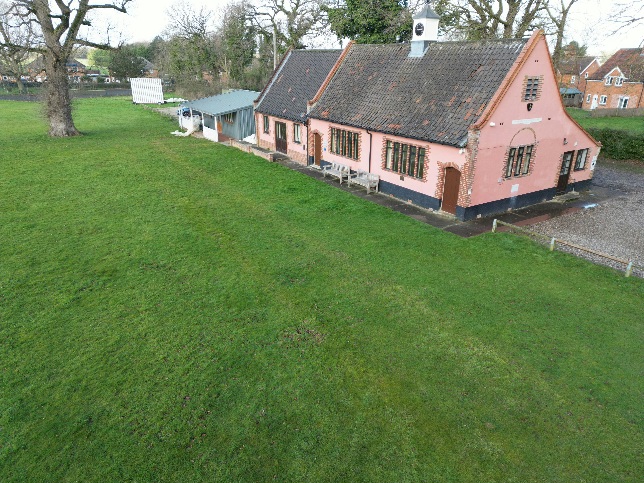
Hardingham Village Hall, also known as the Hardingham Memorial Hall, was built in 1920 as a memorial to the villagers who died during the First World War. The hall was a gift to the village from Mrs Edwards and Captain B. M. Edwards of Hardingham Hall, reflecting the family's long-standing support for the local community. The building was designed by the renowned architect M. H. Baillie Scott, a leading figure in the Arts and Crafts movement.
When it opened in 1920, the hall was intended as a flexible community space. Contemporary descriptions note that it contained a large main hall, kitchen, and retiring rooms. A sliding partition allowed the building to be divided into separate spaces when required, making it suitable for a wide variety of village activities. The structure was built using local materials, including brick, pantiles, and oak timber, giving it a character that blended with its rural Norfolk surroundings.
The hall stands on the village playing field at High Common, land that was also given to the village by the Edwards family after the First World War. Over the decades it has remained at the heart of village life, hosting clubs, societies, meetings, events, and the annual village fête. Even as many traditional village facilities, including the railway station, school, shop, pubs, and chapel, have disappeared, the Memorial Hall has continued to serve as a focal point for the community.
Today, Hardingham Village Hall remains both a practical community venue and a lasting memorial to the sacrifices of the First World War, preserving an important piece of the village's history while continuing to support community life more than a century after its construction.
Our investigation